Appreciate bugs!
Katherine Smith Awesome Site
Reading List
2026-01-02
In which I write a little about books that I really really liked. I do not write too much about them because A) I do not want to, and B) I want you to find out.
I have another (secret) list of books that I loathed but I will not talk about that here. It’s really easy to prompt me to rant about some of them though, so there’s a conversational cheat code you can exploit.
Children of Time

If I had a nickle for each time I read a book by Adrian Tchaikovsky and the theme was “spiders and empathy”, I’d have two nickels. Which isn’t a lot, but it’s weird that it happened twice.
Disliking spiders might actually add to the literary experience, but I do not know that with certainty because I love spiders ♥♥♥
The Murderbot Diaries

This is comfort food in literary form. When a new book in this series releases I retreat into bed for an entire day and then regret that because I read it too quickly.
They made a TV adaptation of the first book and I actually really liked it. One should definitely watch the show and read the book though. Or read the book and watch the show. They compliment each other really well.
They Thought They Were Free
World War II ends and the author travels to germany to befriend ten nazis. He records their stories and worldviews. This book casts light on disturbing aspects of the human psyche and I think that more people should read it, especially in our current times.
Unmasking Autism
In which some guy talks about autism and directly calls me out every three paragraphs or so. Maybe he’s calling you out too? Idk go read it.
Whipping Girl
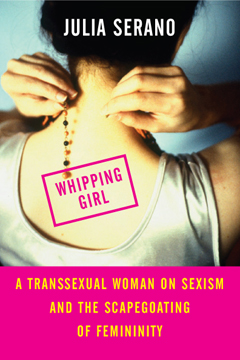
This is where the term “transmisogyny” came from! It is a bit dated, but most of the general concepts hold true. It should be required reading for everyone before they talk to me. Unfortunately, I have not yet found a means to enforce this…
Of Mead and Meadlars
2025-12-25
Mead is great! In case you do not know, mead is the product of fermenting honey. Usually there are spices added to it, but it can be quite flavourful on its own. I first tried it a few years ago and became obsessed.
I’ve tried making my own mead. It can be a relatively simple process. One of the difficulties of finding recipes online is that people like to use weird measurements. Cups, ounces (volume), ounces (weight this time!), pounds, gallons (what the [insert things employers would dislike me saying here] is a gallon?), or a handfull. Most difficulties in the process arise from this, and it helps to have a set of good sources. If you’d like to learn more, please visit meadmakr and the modern mead-making wiki.
Mead (1L, 7.5p ABV)
- 200g honey
- 1g go-ferm
- 1g yeast (notes on this below)
One’s choice of yeast creates a large difference in flavour. The most obvious difference is that some yeasts are capable of fermenting to a far higher alcohol percentage than others. Another aspect of this, however, is a marked difference in flavour! I tested this by preparing three small batches of mead which fermented in the same conditions for the same amount of time, but with different yeasts.
For this experiment I used EC-1118, D47, and K1-V1116. EC-1118 resulted in a fairly standard mead. D47 resulted in a similar, yet a bit more flavourful mead. The result from K1-V1116 was almost overpowering in its strong fruity flavour! With this data, I think that I will use K1-V1116 for my lower-ABV meads.
And now for something vaguely tangential!
Odds are that you have never eaten a medlar.
You might not even know what a medlar is!
In that case, you are one of today’s lucky 10,000.
Medlars are like if you had a big rose bud that was full of applesauce that as spiced with cinnamon.
They usually cannot be eaten off of the tree they grow from, being picked and left to rot ferment a bit until they’re nice and squishy.
To my mouth, medlars are absolutely delicious (though they can be quite a polarizing fruit).
The reason I know about medlars is that we grow them at the UVic Campus Community Garden. It is a neat place which you should check out (and I’m not just saying this because I’m on the board!).
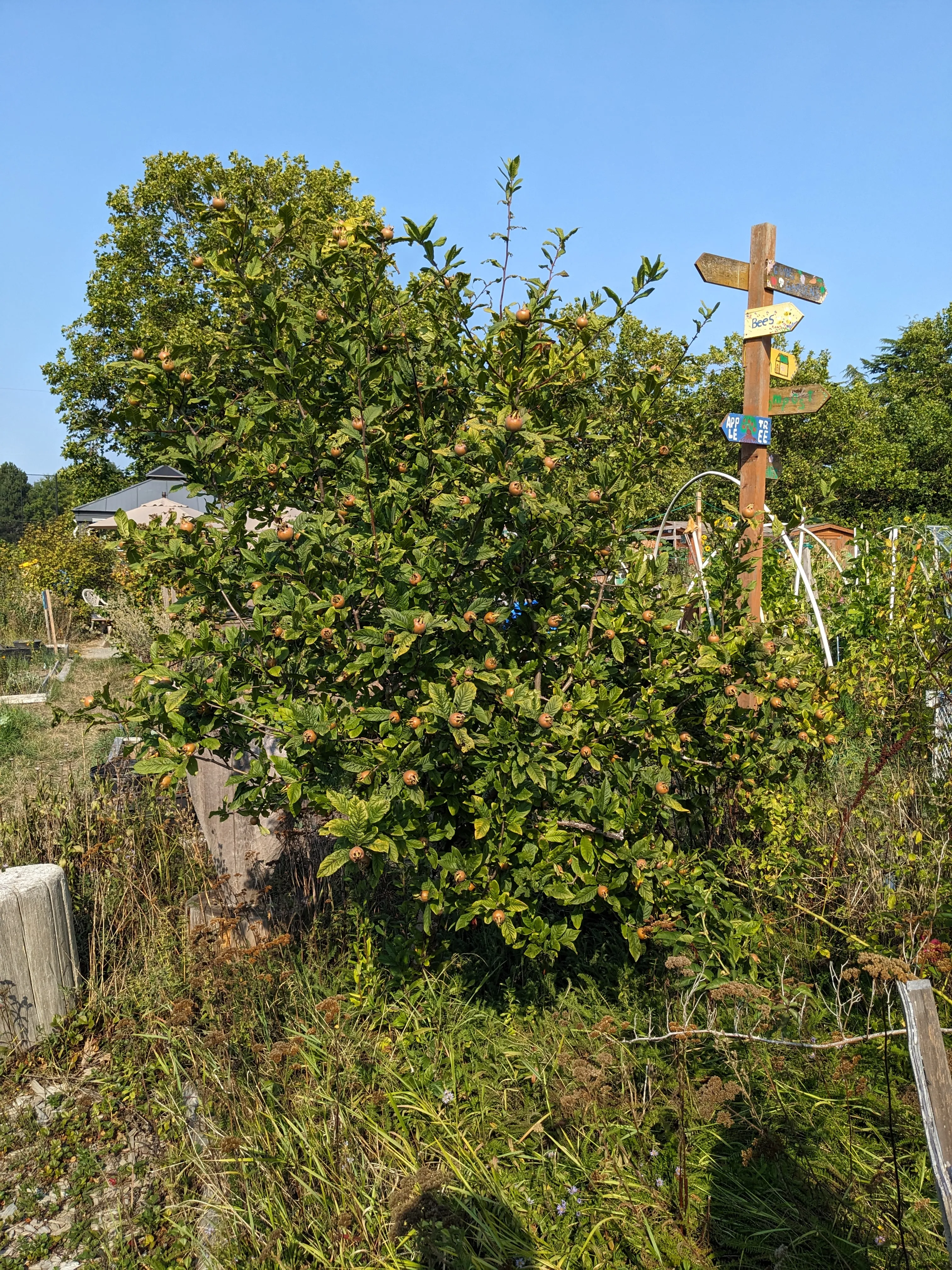
Last year I tried making some things from the medlars. I made some medlar spread (which was nice), but also some medlar mead! That medlar mead turned out a bit too alcoholic (because I’d been too lazy to measure the starting sugar and also messed up with some calculations) and didn’t taste quite as strongly of medlar as I’d have liked. People enjoyed it though, and it was fun to share!
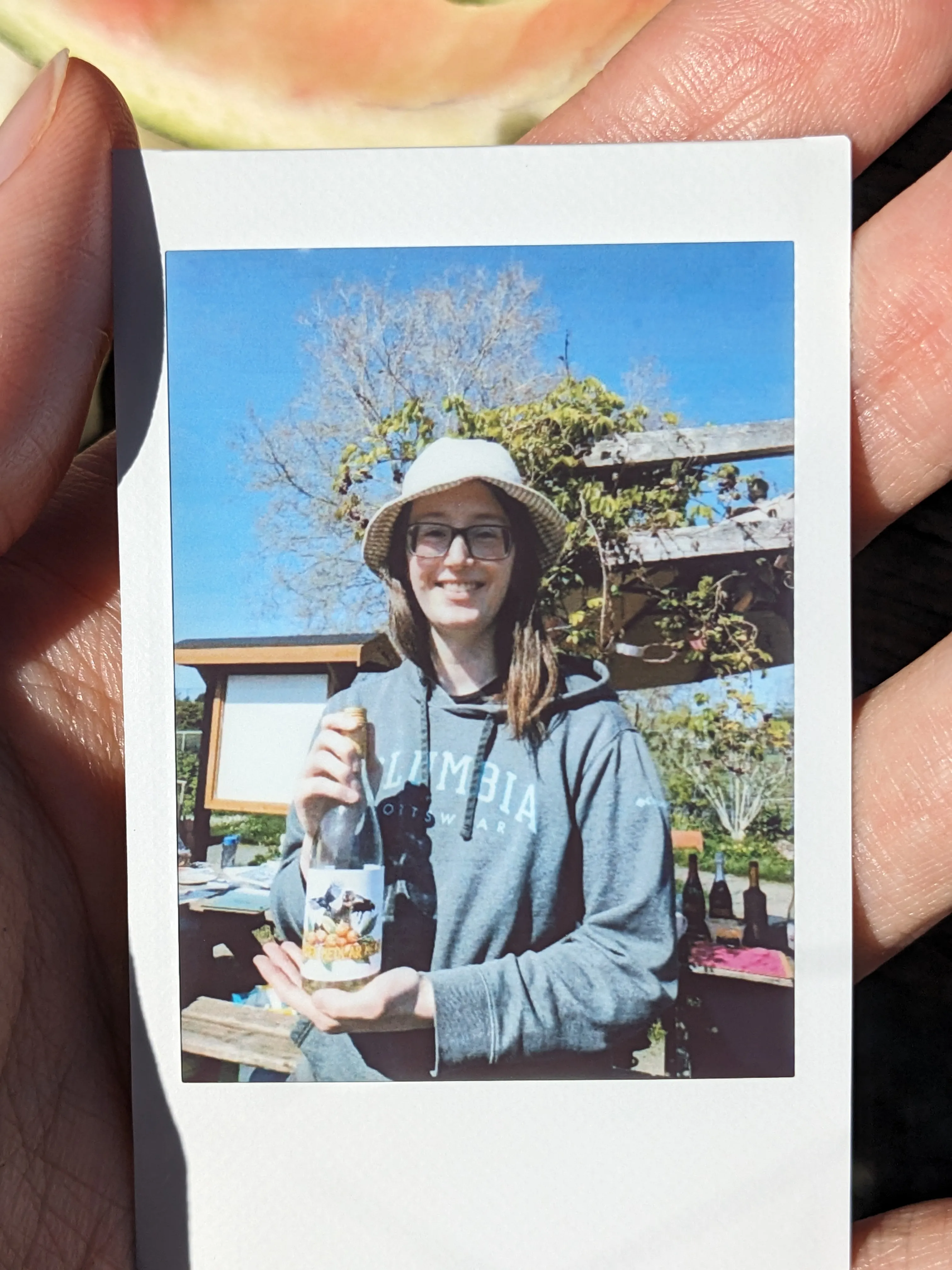
But this year we had a problem… we had way too many medlars! Apparently the Medieval Course Union was supposed to take them and make things with them, but this also apparently never happened. So it came to pass that I was given a large number of overripe medlars to make things with.
I made medlar mead. The medlars were already a bit funny, with one of my friends describing eating one as akin to taking a shot, so I thought them not particularly suited to non-brewing activities.
Medlar Mead (2L, ??p ABV)
- 800g medlar
- 300g honey
- 1g go-ferm
- 1g yeast (K1-V1116)
The resulting ABV from this mead will be unknown, as I did not measure the sugar content. I estimate that the honey will add 5p, but I am not sure about the sugar content of the medlars (they were pretty sugary though!).
It seems pretty goopy right now and did overflow a bit due to the bubbles created by the yeast. I must leave this to ferment for a month, then strain it, and then leave it for another two months. I will get back to you once I have updates.